
Media organizations and e-commerce platforms are hitting a predictable operational wall with generative AI. The underlying foundation models can instantly produce ten thousand editorial illustrations, localized video thumbnails, or product hero images, but the newsroom still relies on human editors to decide if those assets are actually usable. This manual, “gut feeling” approach to quality assurance is the single biggest bottleneck preventing digital platforms from achieving true scale with AI. The solution requires a fundamental shift from subjective visual reviews to programmatic evaluation. By deploying automated quality assurance layers that score every generated asset against strict, plain-English brand guidelines, engineering teams can guarantee quality at scale before a flawed image ever reaches a human editor or a live content management system.
The Content Volume Paradox in Modern Publishing
Digital publishing volume is skyrocketing. Whether a platform is generating hyper-localized news variants, thousands of personalized video thumbnails, or automated feature graphics for high-turnover programmatic SEO pages, the mandate from leadership is universally clear: produce more, faster. Yet, the final mile of this production process remains stubbornly analog and dangerously slow.
According to analysis by Digiday, while a vast majority of digital media executives are experimenting with generative AI for content creation, integrating these tools into daily, high-volume workflows is severely hampered by quality control concerns. If an engineering team spins up an automated pipeline designed to generate 5,000 hero images a day for an affiliate commerce network, deploying a team of photo editors to manually approve each asset entirely defeats the economic purpose of the automation.
The failure rate of generalized base models is a known variable. Models frequently spawn extra fingers on subjects, inject bizarre spatial artifacts into backgrounds, hallucinate text overlays, or completely ignore established brand color palettes. In the media sector, where audience trust is the ultimate currency, blind publication of these raw outputs represents a catastrophic brand risk. The gap between simply “generating an image” and “publishing a trusted editorial asset” is entirely governed by QA. When that QA relies on a junior editor’s gut feeling and a fragmented Slack channel of manual approvals, the system inevitably breaks under volume. To fix this, platforms must stop treating QA as an editorial task and start treating it as a programmable engineering function.
Defining “What Good Looks Like” with Eval Profiles
To solve the manual review bottleneck, technical teams must translate the highly subjective concept of “good design” into explicit, machine-readable parameters. This is the structural foundation of an automated evaluation layer. Instead of hoping a generative model outputs a usable image on the first try, platform engineers are constructing detailed Eval Profiles: structured rubrics that define exact goals and quantitative scoring dimensions.
According to research from Gartner on AI Trust, Risk, and Security Management (AI TRiSM), enterprises that proactively implement dedicated AI guardrails and model monitoring achieve significantly higher adoption rates and project success than those relying on ad-hoc human oversight. In the context of visual content generation, these guardrails are categorized into two primary axes: Quality and Accuracy.
Quality measures the technical execution of the asset. Is the image sharp? Is the lighting realistic? Are the proportions of the subjects anatomically correct? Accuracy, on the other hand, measures how closely the asset adhered to the initial prompt and the broader brand mandate. If the prompt requested a “minimalist flat-vector illustration of a green sneaker,” an output of a photorealistic, neon-green boot might score high on Quality but would fail entirely on Accuracy.
By establishing formal Eval Profiles that separate these dimensions, publishers stop asking the vague question, “Does this look okay?” and start asking the empirical question, “Does this output score above 85% on our internal accuracy metric?” This paradigm shift moves the conversation from subjective aesthetics to predictable, data-driven engineering standards. When you codify these rules, you create a baseline that allows for infinite scaling of content production without requiring a proportional increase in editorial headcount.
The Criteria Framework: Translating Brand Standards to Code
The actual mechanics of automated evaluation rely on setting explicit benchmarks using natural language, effectively training an LLM-powered judge to act as your strictest, most uncompromising art director. A generalized AI model does not inherently know your publication’s specific style guide or your marketplace’s product photography rules. Research surrounding visual journalism from Nieman Lab emphasizes that as newsrooms experiment with visual AI, maintaining a cohesive, trustworthy aesthetic is paramount to retaining audience engagement. A robust Criteria Framework allows technical teams to inject that cohesion programmatically.
This framework requires defining strict “Good” and “Bad” criteria. For example, a digital technology magazine generating editorial headers might set its Good criteria as: “clean white background, high-contrast minimalist vector illustration, visually stunning, strictly utilizing a monochromatic blue palette.” Conversely, the Bad criteria must be equally explicit and aggressive: “photorealistic humans, extra limbs, mutated hands, objects in background, text overlays, visible artifacts, or photorealistic animals.”
By feeding these parameters into a unified API surface—such as the Eval tools available through apiai.me—the pipeline can automatically assess every generated asset against these specific binary requirements. This is not a fragile, hard-coded computer vision script relying on pixel mapping; it is a natural language evaluation engine acting as a semantic filter. The model knows exactly what conceptual elements to look for and, more importantly, what specific flaws must trigger an instant rejection. It bridges the gap between the creative director’s intent and the automated pipeline’s output.
AI Reasoning: Explaining the Verdict to the Newsroom
A core tenet of adopting AI in high-stakes media and e-commerce environments is explainability. If an automated system rejects a batch of product images, the human operators overseeing the broader platform need to know exactly why. A black-box rejection breeds deep frustration among editorial teams and makes pipeline debugging a nightmare for ML engineers. According to MIT Technology Review, the demand for “explainable AI” (XAI) is surging because human operators require transparent context to truly trust autonomous systems with critical business workflows.
This is where the concept of “AI Reasoning” within the evaluation layer becomes operational reality. When an automated evaluation engine reviews an asset, it shouldn’t just output a raw numerical score. It must provide detailed textual explanations—a programmatic feedback loop. Imagine a generated header image for a financial report that receives a “Fail” Verdict. The accompanying AI Reasoning output might read: “Image rejected due to visible smudges and creases in the background, violating the ‘clean corporate aesthetic’ criteria, alongside the presence of distorted, unreadable text overlaid on the generated charts.”
This detailed, semantic feedback transforms the QA process entirely. Instead of a platform engineer staring at a rejected image trying to guess which part of the prompt failed, the pipeline provides actionable, targeted data. This allows the team to immediately tweak the upstream generation prompts, adjust negative prompts, or swap the underlying generation model to correct the specific issue. Verdicts like Pass, Review, and Fail evolve from being arbitrary machine guesses into trusted, explainable operational states.
Programmatic Feedback Loops and Trend Monitoring
Evaluating individual images is only half the operational battle; the true strategic value of an automated QA layer lies in aggregate trend monitoring. Generative AI models are notoriously subject to silent drift. An image generation endpoint that performs flawlessly on Tuesday might receive an unannounced backend update on Thursday, resulting in degraded outputs that slowly poison your content management system over the weekend. Monitoring this degradation manually is impossible when generating thousands of assets a day.
A report by McKinsey on scaling generative AI notes that robust MLOps practices—specifically continuous performance monitoring and automated drift detection—are the primary differentiators between organizations that successfully scale AI and those stuck in perpetual, low-volume pilot phases.
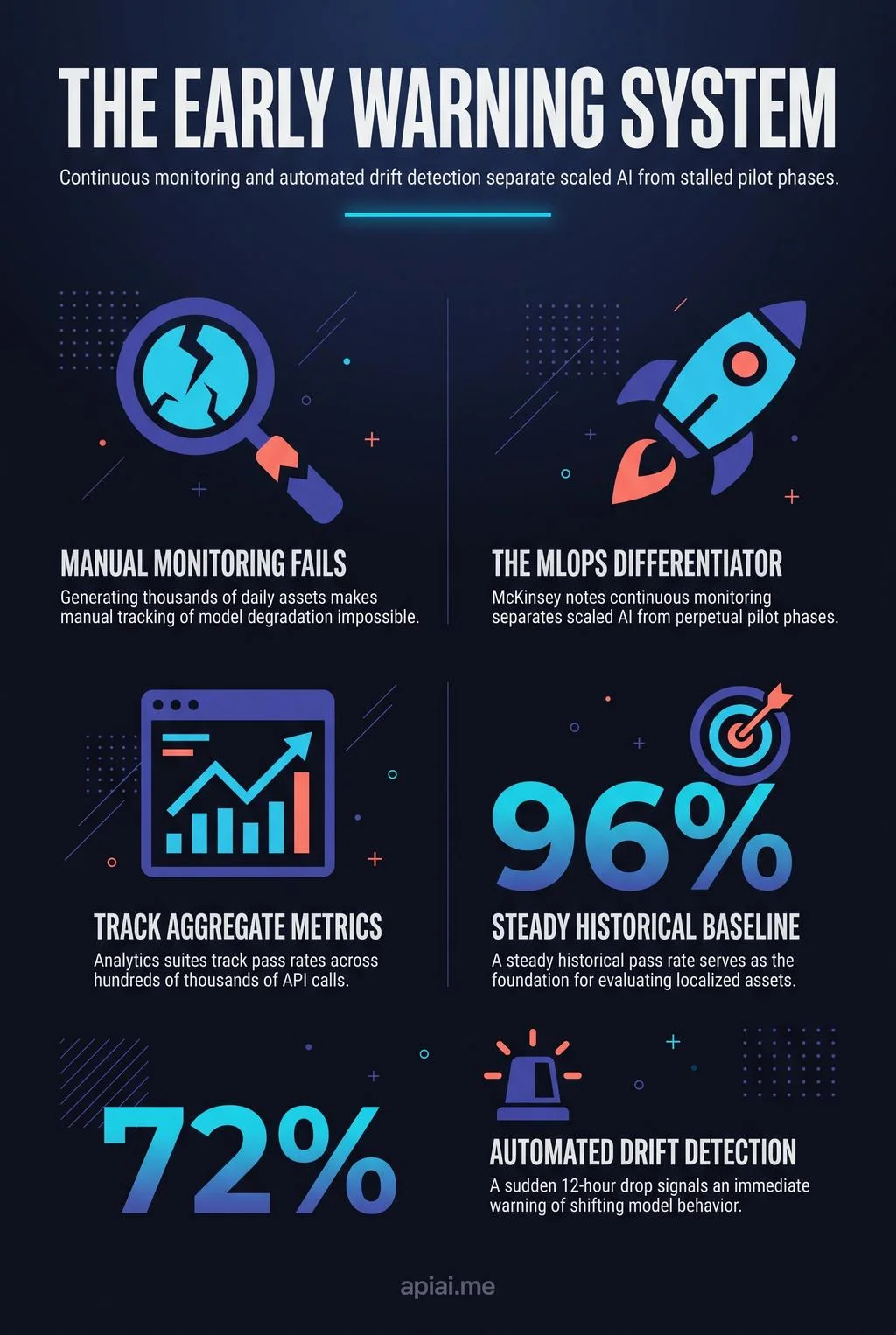
By utilizing an Analytics suite attached directly to the evaluation layer, engineering leaders can track critical aggregate metrics like Pass Rates and Average Scores across hundreds of thousands of API calls. If the historical Pass Rate for your localized sports thumbnails sits steady at 96%, but suddenly drops to 72% over a 12-hour period, the analytics dashboard acts as an immediate early warning system. It indicates that the underlying model behavior has shifted, the prompt structure has degraded, or the evaluation criteria themselves need recalibration for a new campaign.
This macro-level observability allows CTOs and platform engineers to treat AI asset generation with the exact same rigorous uptime and quality monitoring as their primary web databases. It marks the essential transition from treating AI as a shiny novelty feature to managing it as core, SLA-backed enterprise infrastructure.
The Single Point of Success: Why Unified Interfaces Win
For enterprise media companies, digital agencies, and marketplace operators, the fragmentation of AI tooling is a massive, compounding liability. Stitching together one API for image generation, a separate tool for background removal, a third-party application for upscaling, and a custom-rolled python script for evaluation introduces catastrophic latency, high failure rates, and immense maintenance overhead. The architectural goal must be a single point of success—a unified pipeline where generation, moderation, and programmatic evaluation occur in a single, governed flow.
By leveraging a comprehensive platform like apiai.me, technical teams can build complex, multi-step pipelines where Quality Gate nodes automatically route assets based purely on their Auto-Eval scores. A generated asset that scores a 95% “Pass” is sent directly to the CMS via webhook, completely touching-free. An asset scoring 75% triggers a “Review” status, routing securely to an editorial Slack channel for a quick human sanity check. An asset scoring below 50% is outright “Failed” and seamlessly triggers an automatic regeneration with adjusted temperature settings—all within the same API request.
This automated orchestration is the holy grail of high-volume AI content production. It ensures that brand standards are uncompromisingly maintained, editorial trust is preserved at scale, and highly paid human talent is reserved strictly for high-leverage creative decisions, rather than mind-numbing pixel-peeping.
Takeaways for Media and Platform Engineering Leaders
- Codify the Vibe: Stop relying on manual aesthetic reviews. Translate your publication’s visual style guide into strict, plain-English “Good” and “Bad” criteria to enable programmatic evaluation.
- Demand Explainability: Ensure your automated QA layer provides transparent, textual AI Reasoning for every Verdict. Black-box scores make pipeline optimization and debugging impossible.
- Monitor for Model Drift: Treat generative model outputs like server uptime. Track aggregate Pass Rates and Average Scores through an Analytics suite to catch silent model regressions before they degrade your live content.
- Automate the Routing: Implement Quality Gates in your generation pipelines. Automatically publish high-scoring passes, flag borderline cases for human review, and instantly regenerate failures without requiring human intervention.