
The transition from experimental AI generation to operational publishing pipelines is accelerating. For the past two years, media companies and digital publishers have treated generative AI as a sandbox, relying on isolated tools and ad-hoc workflows to produce editorial imagery. That era is ending. The recent integration of complex, node-based workflows into serverless cloud environments signals that visual AI is moving out of the local development environment and into the programmatic mainstream. For technical founders and platform engineers in media, this shift necessitates a fundamental rethinking of how digital assets are generated, vetted, and distributed at scale.
Historically, the barrier to high-fidelity, consistent AI image generation has been infrastructure. Now, the challenge is orchestration. As publishers look to automate thousands of asset variations daily, the focus is shifting away from building standalone user interfaces toward integrating robust, multi-step APIs directly into content management systems.
The Evolution of the Editorial Image Pipeline
When generative AI first permeated newsrooms and digital agencies, adoption was fractured. Art directors largely relied on consumer-facing chat interfaces or proprietary Discord bots. While these platforms demonstrated the creative potential of text-to-image models, they lacked the repeatability required for strict editorial guidelines. According to a recent global report by WAN-IFRA, nearly half of newsrooms are actively deploying generative AI for content creation and workflow optimization, yet many struggle to transition these capabilities from individual experimentation to standardized, desk-wide workflows.
To achieve brand consistency, technical teams turned to ComfyUI, a powerful, node-based graphical user interface for advanced diffusion models. ComfyUI allowed engineers and technical artists to wire together granular processes—combining base models with custom LoRAs (Low-Rank Adaptations), ControlNets for structural guidance, and highly specific upscaling algorithms. It provided the exact control needed to ensure that a generated illustration for a financial technology article matched the precise color palette and stylistic constraints of a publisher’s brand.
However, ComfyUI was inherently tethered to local hardware. Running these complex node graphs required significant GPU compute, local Python environment management, and deep technical knowledge. Distributing these capabilities across a global editorial team meant either purchasing expensive workstations for every art director or attempting to host brittle, custom instances of the software on internal servers. The friction of deployment ultimately capped the scale at which publishers could utilize their meticulously crafted workflows.
Why ComfyUI in the Cloud Changes the Game
The bottleneck of local hardware is actively being dismantled. A recent development highlighted by the Hugging Face Blog details how developers can now run custom ComfyUI workflows for free using Gradio on Hugging Face Spaces. This integration effectively abstracts away the dependency management and local hardware requirements that previously hobbled widespread adoption.
By wrapping a complex, multi-gigabyte ComfyUI workflow into a web-accessible Gradio space, engineers can provide editorial teams with a simplified interface. An editor simply inputs a headline or subject, and the underlying cloud infrastructure processes the predefined node graph—applying the correct stylistic weights, structural controls, and output formatting without the user ever needing to understand the underlying architecture.
This is a critical milestone for media operations. It democratizes access to advanced, multi-step generation. More importantly, it validates a core thesis driving modern media tech: visual AI must be decoupled from local hardware to be truly useful at scale. When the underlying compute is offloaded to the cloud, organizations can standardize the aesthetic output of their AI tools across distributed teams, ensuring that an image generated by an editor in London perfectly matches the style guidelines of a designer in New York.
The Hidden Costs of Hosted Interfaces
While moving node-based workflows to cloud-hosted web interfaces solves the immediate problem of local hardware constraints, it introduces a new set of challenges for engineering teams tasked with production-level scaling. A hosted UI is an excellent tool for human-in-the-loop generation, but modern digital publishing increasingly demands programmatic automation.
Relying on hosted interface wrappers for production workloads often exposes teams to the hidden costs of “free” or shared infrastructure. According to forecasts by Gartner, by 2025, 70 percent of enterprises will prioritize cloud-based AI services over building their own infrastructure due to soaring GPU costs and a chronic shortage of specialized talent. However, offloading infrastructure to shared consumer platforms introduces significant operational risks.
First, there is the issue of cold starts and latency. In a fast-paced newsroom or programmatic advertising environment, waiting several minutes for a shared GPU instance to spin up before rendering a breaking news graphic is unacceptable. Second, these hosted interfaces rarely offer enterprise-grade Service Level Agreements (SLAs). If an underlying model deployment goes offline or experiences high traffic congestion, the entire editorial workflow stalls.
Finally, a user interface—no matter how streamlined—still requires manual intervention. An editor must still open a browser tab, input a prompt, wait for the generation, download the asset, and manually upload it into a Content Management System (CMS). When an e-commerce marketplace needs to generate unique, style-consistent background environments for ten thousand new product listings overnight, relying on human operators clicking through a web app is no longer a viable strategy.
From User Interfaces to Programmatic Pipelines
To achieve true scale, media platform engineers are moving beyond cloud-hosted UIs and embracing API-first architectures. An API-first approach allows visual AI to be deeply embedded into the very fabric of the publishing platform, turning image generation from an isolated task into a continuous, automated pipeline.
Consider the workflow of a modern digital agency producing localized marketing assets. An automated pipeline might begin with a base image generation using a specialized diffusion model. Instead of stopping there, the API immediately passes that output to an upscaling endpoint to achieve print-ready resolution. The next node in the pipeline might trigger a background removal tool to isolate the subject, followed by an OCR (Optical Character Recognition) check to ensure no garbled, AI-generated text appears in the final composite.
This level of orchestration requires unified endpoints. Managing separate API integrations for generation, upscaling, editing, and text analysis creates technical debt and fragile codebases. The market is shifting toward unified platforms that allow developers to chain these specific tasks together programmatically. This is why solutions like apiai.me are gaining traction among platform engineers; they provide a single API surface to design, execute, and monitor complex multi-step AI workflows, allowing teams to swap out underlying models seamlessly as the technology evolves.
Brand Safety and the Need for Automated Moderation
As the volume of AI-generated assets scales, human review becomes a critical bottleneck. Generating ten thousand images is technically trivial; ensuring that every single one of those images aligns with strict corporate brand safety guidelines is a massive operational hurdle.
The publishing industry is acutely aware of this risk. According to reporting by Digiday, brand safety remains a paramount concern for publishers utilizing generative AI, with media buyers and advertising partners demanding stringent safeguards to prevent ad placements adjacent to inappropriate or off-brand synthetic content. An unchecked AI pipeline that inadvertently generates culturally insensitive imagery, copyright-infringing material, or anatomically malformed subjects can cause catastrophic reputational damage.
To mitigate this, robust AI pipelines must incorporate automated quality control mechanisms natively. This goes beyond simple NSFW filters. Modern editorial pipelines require dynamic branching logic—Quality Gates—that automatically evaluate generated outputs against plain-English criteria.
For example, an API pipeline generating recipe illustrations for a culinary magazine might include an Auto-Eval node programmed to verify that “the image features appetizing food, no distorted utensils, and zero recognizable human faces.” If the image passes, the pipeline automatically routes the asset to the CMS. If the image scores poorly, the pipeline can either trigger a regeneration attempt with modified parameters or route the asset to a specific queue for manual human review. By embedding moderation directly into the programmatic workflow, publishers can safely exponentially increase their output without scaling their editorial headcount at the same rate.
Orchestrating the Multi-Model Future in Publishing
The rapid evolution of generative AI guarantees one thing: today’s state-of-the-art model will be legacy technology in six months. Tying an entire editorial workflow to a single model provider or a specific proprietary ecosystem is a profound strategic risk.
We are already seeing specialized models outperform generalist models in specific domains. While an open-source model might excel at photorealistic portraits, a proprietary model from DeepMind or ByteDance might offer superior text-rendering or dynamic video generation capabilities. Engineering teams must build their infrastructure to be model-agnostic, capable of routing specific tasks to the most appropriate engine on the fly.
This requires a catalog approach to AI tooling. By building pipelines on top of an aggregated provider network, engineering teams can maintain a stable API integration while hot-swapping the underlying generation engines. If a new, faster version of an upscaling model is released, the pipeline can be updated at the orchestration layer without requiring a complete rewrite of the CMS integration. You can explore how this model-agnostic approach functions in practice by reviewing the unified tool catalogs available at apiai.me/tools, which abstract the complexity of interacting with diverse providers.
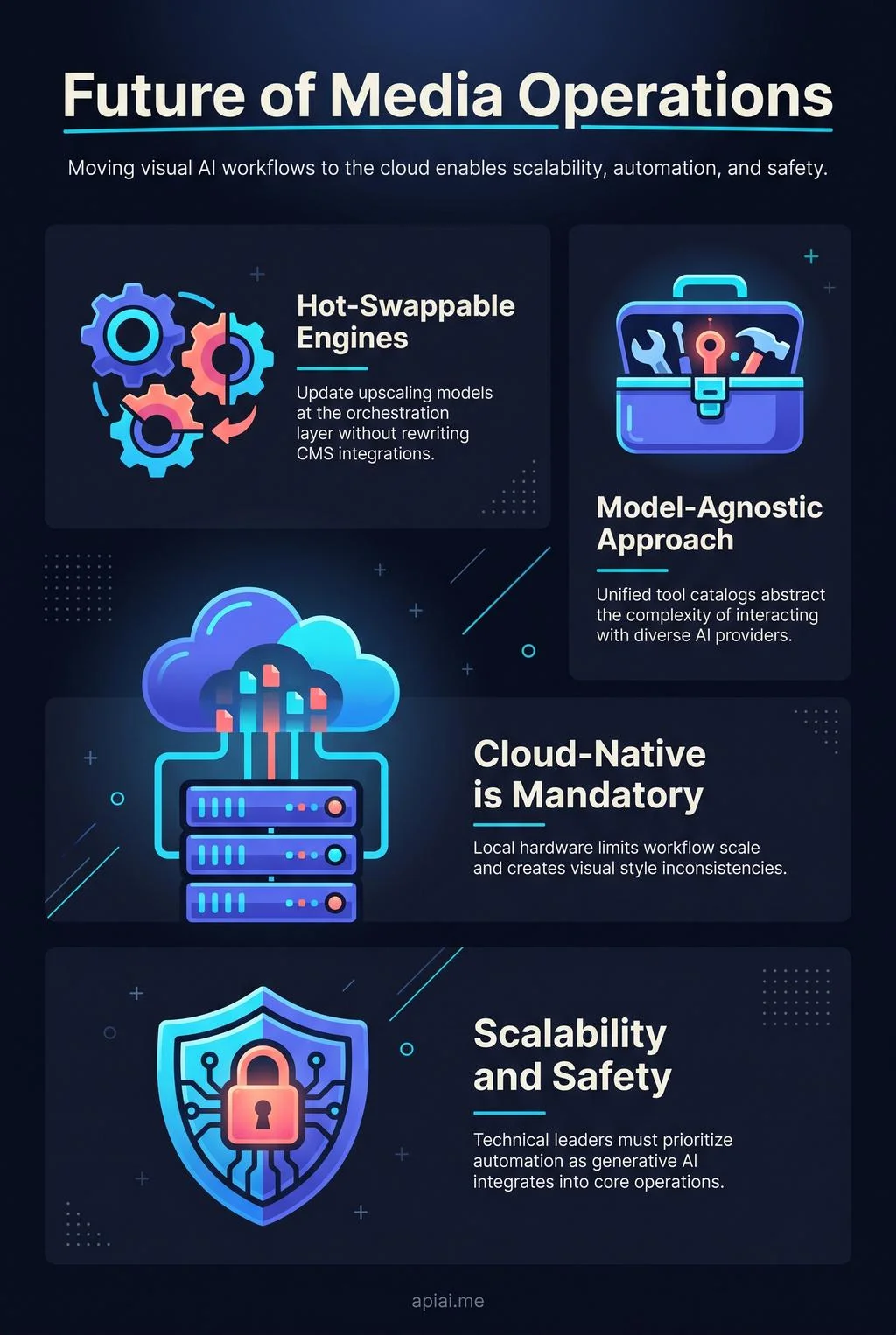
Takeaways: The Future of Media Operations
The migration of complex visual AI workflows from local machines to the cloud is just the first step in a broader operational transformation. As media companies and marketplaces look to integrate generative AI into their core operations, technical leaders must prioritize scalability, automation, and safety.
- Cloud-native is mandatory: Relying on local hardware for editorial asset generation limits scale and creates style inconsistencies across distributed teams.
- APIs beat UIs for scale: Hosted web interfaces are excellent for prototyping and single-user tasks, but programmatic pipelines are required to automate high-volume asset generation and CMS ingestion.
- Unified orchestration reduces technical debt: Chaining multiple distinct models (generation, upscaling, OCR, background removal) through a single API surface is more reliable than managing bespoke integrations for every new tool.
- Automated moderation is non-negotiable: As output volume increases, human review becomes impossible. Pipelines must incorporate programmatic Quality Gates and Auto-Eval scoring to protect brand safety and satisfy advertiser requirements.
- Build for a multi-model future: Avoid vendor lock-in by designing abstraction layers that allow your pipelines to swap models as better, faster, or cheaper options become available.